
Yoga nidrã and birth trauma: coming home to yourself
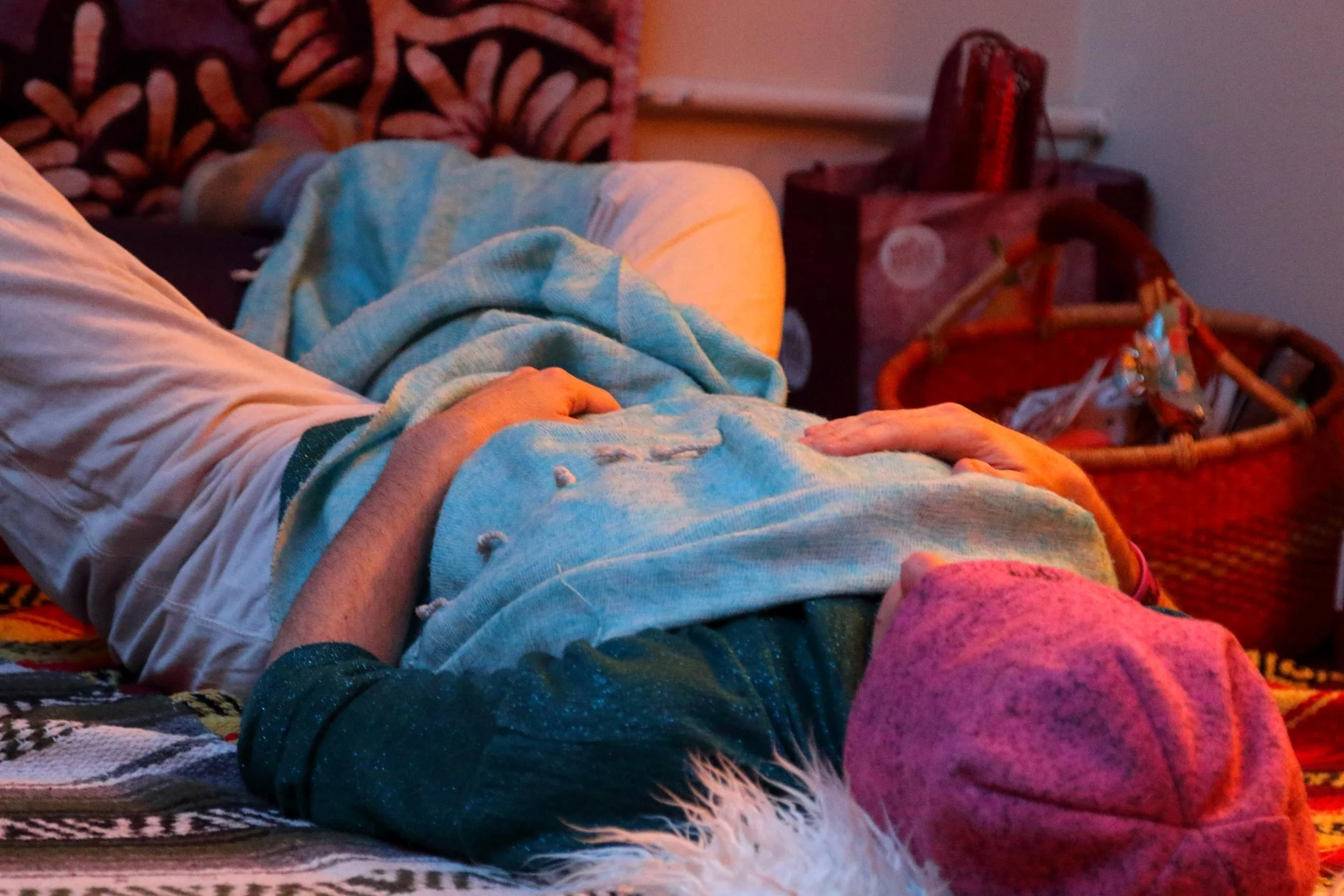
A particular kind of exhaustion follows a difficult birth, pregnancy or postpartum: Not only the physical depletion of pregnancy and labour, though that is real and often underestimated, but the exhaustion of a nervous system that has been on high alert, sometimes for months or years after the birth itself, unable to fully settle because something inside is still holding the experience as unresolved.
For many people with trauma, sleep does not bring the rest it should. Ordinary life continues on the surface while something underneath remains vigilant, scanning for threat, unable to receive the signal that it is over and the person is now safe.
This is where yoga nidrā offers something that few other practices can. Yoga nidrā is sometimes described as ‘yogic sleep’, which is only partially accurate: What distinguishes it from sleep, or from ordinary relaxation, is the unique state of awareness maintained throughout. In yoga nidrā, the body enters a state of profound rest while the mind remains alert and receptive, hovering at the hypnagogic threshold between waking and sleeping. Rather that the unconsciousness of sleep, It is a state of conscious, effortless presence, beneath the level of thinking.
I came to yoga nidrā through Uma Dinsmore-Tuli, in a one-to-one session in Stroud in 2017 (read more in this post). I had been unpicking a twenty-year habit of striving in yoga practice, that was mostly cerebral, goal-oriented, not really listening or responding with any gentleness. Uma guided me into something completely different: a state of deep reception, where my body’s own intelligence could be heard. I left nourished in a way that movement alone had never produced, with a personalised recording I have returned to ever since.
What I did not fully understand then, and have come to understand gradually through practice, teaching, and training, is the specific relevance of this state to trauma.
What the nervous system needs
Trauma, as I explored in a previous post, is not primarily a cognitive problem, but a nervous system problem. After a frightening, overwhelming or unsupported birth, the autonomic nervous system can stay stuck in a state of activation, or conversely in a flattened, shutdown state, unable to find its way back to regulation.
The research on yoga nidrā and the nervous system is increasingly robust. A 2024 paper in the peer-reviewed literature identifies yoga nidrā as an adjunctive treatment of growing interest, with potential to alleviate symptoms of trauma including hypervigilance, sleep disturbances, and disembodiment (Perelman AM, 2024). Studies on veterans with PTSD have shown reductions in PTSD symptoms, self-blame, depression, body tension and sleep disturbance following yoga nidrā practice. Research suggests that yoga nidrā enables individuals to access the subconscious, aiding in the resolution of autonomic nervous system responses and their associated physiological symptoms.
What yoga nidrā does, in physiological terms, is guide the nervous system into the parasympathetic state, the rest and digest mode that trauma disrupts. Not through effort or force, but through the gentlest possible invitation: lie down, be still, nothing to do, or ‘get right’. The systematic rotation of awareness through the body, the pairing of opposite sensations, the movement between inner and outer attention, all work together to restore the flexibility and fluidity that trauma erodes.
This connects directly to what the latest neuroscience is beginning to articulate: that what persists after trauma is not something stored in the body like an object, but a loss of adaptability in the brain’s predictive systems. The brain becomes rigid, over-weighting threat predictions, unable to update. Yoga nidrā, by creating repeated experiences of safety and settled awareness, offers new information to a system that has stopped accepting it, it teaches, gently and repeatedly, that something different is possible.
The sankalpa: intention as medicine
One of the distinctive features of yoga nidrā, in the tradition I trained in with Uma Dinsmore-Tuli and Nirlipta Tuli, is the sankalpa, a short, personal intention that is planted at the beginning and end of the practice, when the mind is maximally receptive.
The sankalpa is not a positive affirmation in the ordinary sense. Nor is it wishful thinking imposed on an unwilling mind. More like a seed sown in fertile ground, at the precise moment when conscious resistance is lowest and the deeper layers of the self are most open. Over time, with repeated practice, the sankalpa takes root in ways that feel less like effort and more like recognition.
For birth trauma, the sankalpa can be extraordinarily potent. A carefully chosen intention, rooted in what emerged in the birth reflection session, in what the person most needs to know or believe about themselves and their experience, has a direct route to the parts of the self that ordinary talking cannot easily reach.
Why a personalised yoga nidrā following a birth reflection helps
This is the rationale behind the personalised yoga nidrā I offer as an option following birth reflection sessions. A birth reflection session does significant work, in that it creates space for the story to be heard, for clinical questions to be answered, for the body’s responses to be noticed and gently attended to. But the work of integration, of the experience finding its place in the larger story of who someone is, rather than sitting as an intrusive fragment that doesn’t belong, continues long after the session ends.
A personalised yoga nidrā, created specifically from what emerged in the session, extends that integration into the body’s own rhythms of rest and restoration. The themes, the specific places of activation or shutdown, the qualities that were present, the things that needed witnessing, all of this can be woven into a practice that the person carries with them and returns to in their own time, in their own space, at the pace that feels safe.
Yoga nidrā is an older and quieter technology than therapy. It works by activating the body’s innate healing capacity rather than directing it. This is part of what makes it adaptogenic: the practice meets you where you are. Someone in hyperarousal with mind racing, body braced, unable to settle, will find the nervous system beginning to slow. Someone in shutdown or numbness may find sensation and aliveness beginning to return. The practice creates the conditions in which the system can find its own way back to balance. You receive what you need, not what someone else decides you need.
Uma Dinsmore-Tuli’s work with yoga nidrā is rooted in the idea of returning to oneself, to the body’s own deep knowing, beneath the layers of stress, striving and held experience. For people who have felt estranged from their own bodies after a difficult birth, that possibility is everything.
