
Q&A with Michel Odent, childbirth wizard and interdisciplinary student of human nature
[Published MIDWIFERY MATTERS Spring issue 168, March 2021]
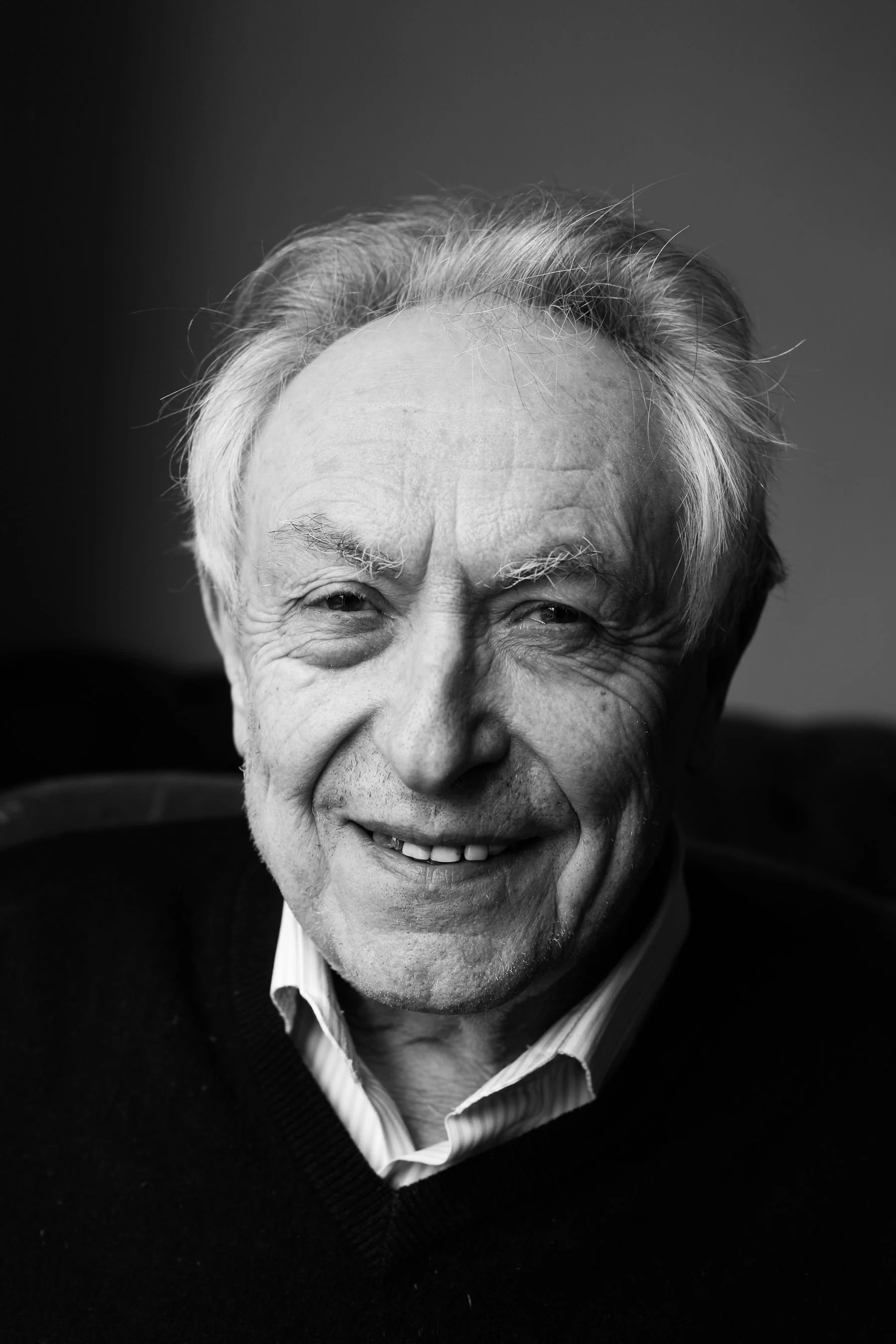
Why do you say we're at 'the edge of the precipice' now, instead of the bottom of the abyss?
It's as if we are at the edge of a precipice - at the limit of the domination of nature. The number of women giving birth to the baby and to the placenta, thanks to the release of what we now consider a cocktail of hormones of love - this number is becoming insignificant because synthetic oxytocin is cheap, used in poor countries and caesarean sections are safe. We don't understand birth physiology, so we make mistakes and birth stops happening. No need to release the hormone of love to have babies - now that's serious. Also today, most babies are not colonized immediately after birth by a great diversity of familiar and friendly microbes, which has serious long term health implications.
Precipice seems marginally less catastrophic than abyss. Why the optimism?
We have an opportunity to reconsider our understanding of the birth process in the light of modern neurophysiology; to introduce new questions about physiology, reframe our thinking. Historically, we have taken a pathological, mechanical approach, looking at what causes problems, asking why was that birth difficult? Now we need to ask, 'why is it that occasionally some women give birth easily and quickly?'
So you're talking about a salutogenic approach instead of a pathological one?
Answers and solutions rely on the point of departure of the question. So we need to focus on what works, not what makes birth difficult. It means instead of studying the origin of diseases, let's understand how we build good health. It is all the same for birth. It's what they call salutogenesis. And today that's why I am concerned with bacteriology.
What's the connection between the fetal ejection and lactation reflexes? We understand better what's happening if we study all the human reproductive processes in parallel at the same time. These processes (copulation, fetal ejection and lactation) have the same characteristics: there is always the first stage, a passive slow phase and an ejection reflex at the end; it's the same mechanism, with, in particular the release of endorphins and a peak of pulsatile oxytocin. It's a big topic, many ways to explain the connection. We can understand it best within the system of endorphins. It's important to study the continuum, not to be specialised in breastfeeding or childbirth, but to understand the whole.
What do you think is the single most important factor for physiological birth?
Firstly, I never use the term physiological birth. Sure I studied birth physiology, but after thousands of years of socialized birth, we don't understand what is really physiological birth - so many interferences and modifications, belief rituals and cultural conditioning. We need to study birth physiology, but avoiding the term physiological birth. Important for us to understand how we have behind us thousands of years of cultural conditioning and that's a difficult handicap to overcome. We can't change that overnight. The most important point to understand is that to give birth, you need to release oxytocin (everybody has heard of oxytocin now!) and this is a shy hormone, it's timid, it actually does not appear in the socialised environment among observers, people you don't know. So that's something that can be explained in a simple way. To give birth, you need to release the shy hormone, oxytocin.
"We need to reconsider the selection criteria for midwifery training. They should be mother figures, not necessarily mothers, but mother is the prototype of the protective person."
So you refer more to socialization than medicalisation of childbirth?
For me, medicalisation of childbirth is just the ultimate phase of socialized birth. In 'The future of Socialised birth', the last chapter in my recent book, The Future of Homo, I talk about the masculinisation of birth; until the middle of the 20th century, childbirth was women's business and birth became more socialised with the presence of male doctors. It started with the domination of nature, before that, women used to isolate themselves to give birth - that was the turning point. We have to recognise this turning point to appreciate our deep cultural conditioning.
Is a paradigm shift possible?
Changing the way of thinking is not impossible in the context of modern neurophysiology. It's perhaps utopian, but not impossible. At the present time, the deep rooted misunderstanding of physiology is cultural. It's not to do with obstetrics, doctors are just a part of cultural conditioning. It's particularly strong amongst those who promote what they call 'natural childbirth' Look at this book: [shows "Husband Coached Childbirth - The Bradley method of natural childbirth"] You cannot coach an involuntary process, you cannot guide it, you can only protect it. And who is the coach? A man. Method and natural are incompatible words.
What would you say about the war on normal birth, and so-called cult of normality?
I never associate birth with an adjective, normal or physiological. Normal means culturally acceptable. At the present time, some women say that they had a normal birth because it was vaginal but they had an oxytocin drip. We must forget normal, we don't even know what it means. To try to change the way of thinking we have to change the words we use to talk about birth. Can a modern woman simply say, for example, I wish to give birth by myself?".
What can midwives do to ease this paradigm shift?
We need to reconsider the selection criteria for midwifery training. They should be mother figures, not necessarily mothers, but mother is the prototype of the protective person. And this protection is the most important part of the midwife's role. Birth is an involuntary process You cannot help an involuntary process, but you can protect it against individual factors ie stimulants of the neocortex: language, obligations to pay attention or a release of adrenaline, for example, if it's cold or there's a stressful atmosphere.
What advice would you give to student midwives?
Establish links between disciplines. Remember the origin in French of midwife is sagefemme, that means wise woman, the one who knows a bit of everything. Be careful not to be highly specialized, too much medicalized.
What is your most radical idea?
The vocabulary of protection. And the concept of neocortical inhibition. It is key to understanding human nature in general and human birth in particular, that the neocortex can inhibit physiological processes. Something which is not understood easily, but it can be understood if you explain how archaic primitive reflexes disappear as the neocortex develops, for example, how humans are unable to swim. Now we have to learn the technique to swim because of our cortical inhibition.
What question do you love to be asked?
What is special about homebirth?' is the main question to reach a new awareness. When a woman gives birth at home, it is among a great diversity of familiar microbes and micro-organisms. And because human babies are the same IgG as the mother, the bacteria that are familiar for the mother will already be familiar for the baby too. The IgG easily crosses the human placenta. Until recently, when babies were born, the body was immediately colonized by a great diversity of familiar (and therefore friendly) microbes, and this is how the human system gets 'educated' or 'programmed'. Nowadays, it is the opposite. Babies are born among unfamiliar microbes and there is a lack of diversity when you give birth in the hospital, so the human system is not initially programmed in the same way. In terms of how our health and the developing system are organised, there are two kinds of birth: home birth and birth elsewhere. You cannot imitate homebirth from an immunological perspective. So we have to phrase new questions, focus our research into autoimmune and viral diseases, on birth setting: at home vs 'elsewhere’.
What are you working on now?
I am currently finishing a book about the special relationship between Homo and water, titled Homo and the Blue Planet. Subjects as diverse as the common points between Homo and sea mammals, the colonisation of the Pacific Ocean and the Mediterranean basin by 'Homo Navigator', the fluctuations of sea levels during the palaeolithic age, the brain selective nutrients, and the reasons our species needs to learn to swim - are combined to reach a new vision of human nature.
ABOUT MICHEL ODENT
Odent is well known as a childbirth specialist, former head of the surgical unit and the maternity unit at the Pithiviers state hospital (1962-1985) and founder of the Primal Health Research Centre (London). He wrote the first article in medical literature about the initiation of lactation during the hour following birth (1977), the first article about the use of birthing pools (Lancet 1983), and the first article applying the 'Gate Control Theory of Pain' to obstetrics (1975). He is the author of 16 books published in 24 languages.